Share Aura
Evolving Expressive Run Sharing Through Intentional Storytelling
Role:
Product Designer (Concept Exploration)
Scope:
Vision-Led Product Refinement
Platform:
iOS (Mobile)
Timeline:
Personal Exploration
Overview
Share Aura is an iOS running app that transforms Strava data into expressive, shareable visual artifacts. Through presets, templates, and stylized collages, it reframes run sharing as creative self-expression rather than pure performance reporting.
This exploration examines how Share Aura's expressive system could evolve to better support intentional storytelling, helping runners communicate not just what they ran, but what the run meant.
Cultural & User Context
Running culture has expanded beyond competition and metrics into identity, lifestyle, and creative expression. For many runners, sharing a run is less about validation and more about signaling mood, discipline, environment, or personal growth.
Yet most run-sharing systems still center performance as the dominant narrative. Pace, splits, and heart rate define the hierarchy, while emotional context remains secondary or implied.
Creative athletes increasingly want their shared runs to feel human and personally meaningful. They are not just documenting distance. They are expressing intention.
DESIGN THESIS:
Run data is neutral. Narrative is not.
While Share Aura enables rich visual expression, performance metrics often remain the implicit center of the story. If the same dataset can support multiple meanings, intent should shape how that data is framed.
This exploration investigates how introducing intent as a first-class input could transform expressive run sharing from aesthetic assembly into deliberate storytelling.
Product Focus
If Share Aura did ONE things exceptionally well, it would be…
Help runners tell a clear, intentional story about the mood, effort, or experience of a single run.
A single run is the most emotionally honest storytelling unit.
Share Aura already excels at aesthetic customization.
The opportunity lies in guiding intent, not adding more visual variety.
Why Focus on a Single Run?
What This Exploration Intentionally Did Not Design
Social feeds or discovery systems
Performance analytics tools
Competitive or leaderboard mechanics
Monetization or onboarding flows
Restraint was essential to maintain clarity. This was not a redesign of the ecosystem, but a refinement of narrative structure.
Design Principles
Story Before Stats
Emotional intent defines hierarchy. Metrics support the narrative rather than dominate it.
Guided, Not Perspective
The system offers direction without limiting creative control.
Immediate Emotional Read
Within three seconds, the artifact should communicate how the run felt.
Hierarchy Creates Meaning
What is visually prioritized communicates what mattered most.
Flexibility Without Noise
Optional data enriches the story but never overwhelms it.

Design Opportunity
Share Aura’s creative tools are powerful, but storytelling often happens incidentally through aesthetic composition rather than intentional framing.
The opportunity was to introduce a lightweight storytelling layer that clarifies what a runner wants to express before generating a visual artifact.
Design Solution:
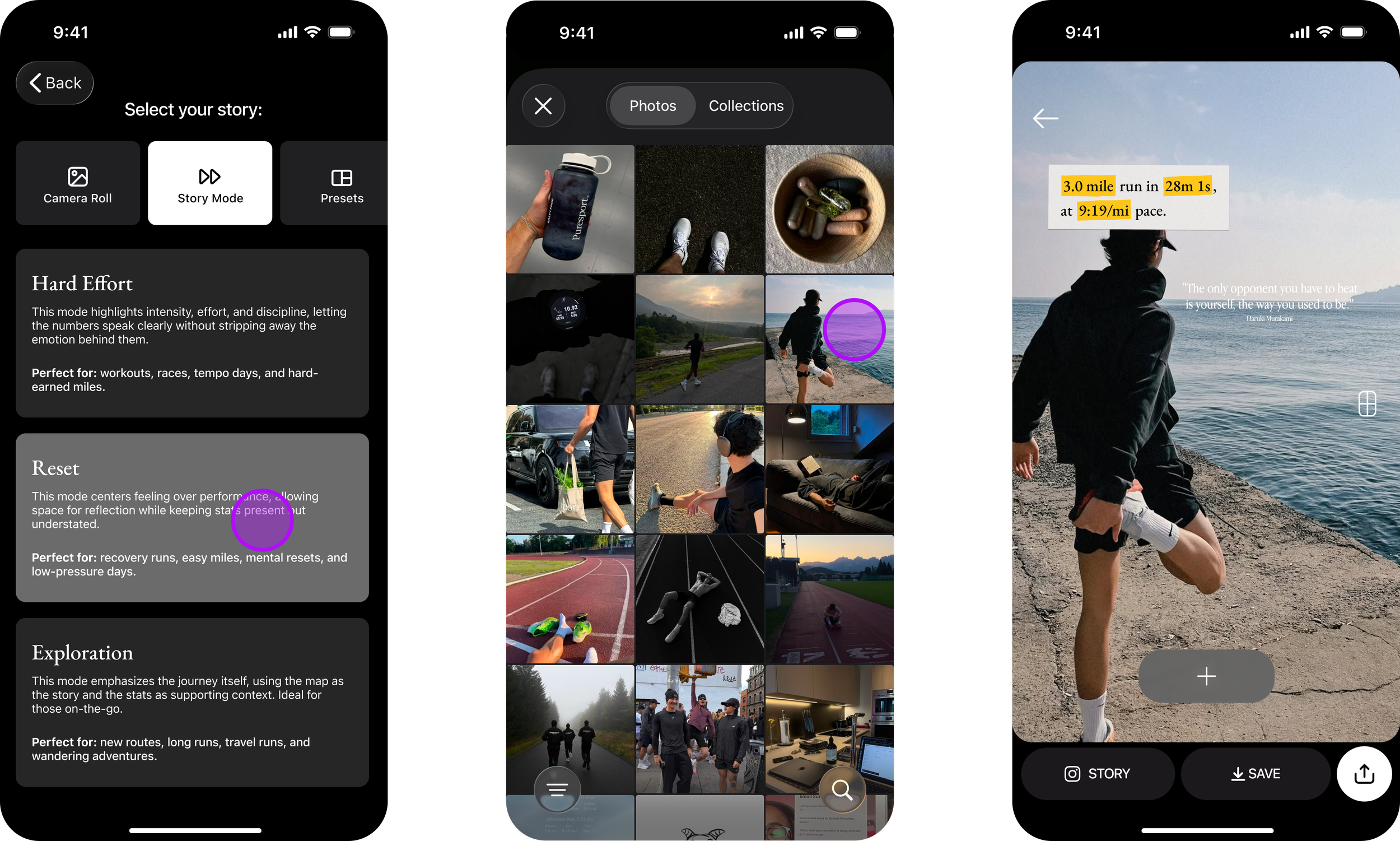
Story Mode Builder
Rather than introducing new templates or styles, this exploration proposes a structural layer: Story Mode Builder.
Story Mode is an optional narrative input that allows runners to define the emotional intent of a run before generating a shareable artifact.
By selecting a Story Mode, users subtly influence:
Visual hierarchy
Metric emphasis
Typography scale
Layout density
Caption framing
The same run data can produce entirely different artifacts depending on the selected intent.
Story Mode does not constrain creativity. It acts as a narrative compass, guiding how existing expressive tools are applied so the final artifact communicates what the run felt like, not just what happened.
Story Modes
Hard Effort
For runs defined by intensity, discipline, and physical demand, where performance and effort take the lead.
Perfect for:
Workouts, races, tempo days, and hard-earned miles.
Asset Hierarchy:
Primary: Pace, Splits, Heart Rate
Secondary: Route Map
Supporting: Short Caption or affirmation
Quiet Reset
For runs defined by intensity, discipline, and physical demand, where performance and effort take the lead.
Perfect for:
For runs centered on mental clarity & recovery, where how the run felt matters more than how it performed
Asset Hierarchy:
Primary: Reflection, Mood, or Quote
Secondary: Route as atmospheric backdrop
Supporting: Short Caption or affirmation
Location Exploring
For runs driven by curiosity and environment, where the journey and route tell the story.
Perfect for:
New routes, travel runs, long runs, and wandering adventures.
Asset Hierarchy:
Primary: Route and environmental context
Secondary: Distance and duration
Supporting: Annotations or commentary
Run Story Artifacts
Using the same run dataset, multiple artifacts were generated to demonstrate how Story Mode changes tone, emphasis, and narrative clarity without limiting expression.
The goal was not to create different designs, but to create different stories.
Each artifact was evaluated against a single question:
“What does this run feel like within the first 3 seconds?”
Existing Share Aura Flow
Users move directly from run synchronization into artifact customization, with no structured opportunity to define intent.
Proposed Share Aura Flow
Users first select the emotional intent behind their run, establishing the narrative that guides artifact creation.
Story Mode Selection
After choosing a Story Mode, users receive curated starter assets aligned to their selected narrative while retaining full customization control.
Different Stories, Same Run
Using identical run data, Story Mode changes hierarchy and emphasis to produce distinctly different narratives.
Future Exploration: Assistive Intelligence
Story Mode establishes intentional framing. A future intelligence layer could assist runners in shaping that story more efficiently.
Potential opportunities include:
Suggesting Story Modes based on run characteristics
Learning preferred artifact structures over time
Recommending layouts aligned with past behavior
The system remains user-directed. Intelligence acts as a co-pilot, accelerating expression without removing control.
Evaluation
Success would be evaluated across three areas:
Activation
Percentage of synced runs converted into completed artifacts.
Time from synchronization to share.
Adoption
Story Mode selection rate
Repeat Story Mode usage across sessions
Engagement
Share and export rate
Retention among Store Mode users versus non-users.
Reflection
This exploration began with a simple discomfort: many of the most meaningful runs in my own life would look unimpressive if reduced to pace and distance alone.
Some were slow. Some were quiet. Some were messy. Yet the systems we use to share them often elevate performance as the primary signal of value.
Working through this project shifted my perspective from designing expressive outputs to designing narrative structure. I became less interested in adding new aesthetics and more interested in shaping hierarchy. The most powerful lever was not visual style. It was deciding what gets emphasized first.
Story Mode emerged not as a feature idea, but as a reframing: what if we asked runners what the run meant before we asked how it should look?
This project reinforced something I now carry into other work: expressive products are not just about creative freedom. They are about helping people communicate what matters clearly.
Sometimes the most impactful design decision is not adding more, but choosing what leads.